The “80+” Travel Trap: Why a Stamped Paper Matters More Than Your Insurance Policy

Editor’s Note: This post has been updated to reflect our “ground reality” from May 2026. While we prepared extensively for administrative challenges, our experience at the gate offered a surprising twist on the “Fit to Fly” requirement.
When I started planning our ancestral pilgrimage to China, my biggest worry was the “Insurance Gap.” But after digging into the 2026 regulations for the airline that we’re flying with, and the CAAC (Civil Aviation Administration of China), I realized the real threat isn’t just a lack of medical coverage—it’s the very real risk of being denied boarding at the gate.
Here is how we are navigating the high-stakes logistics of flying an 85-year-old to the motherland.
1. The Authority Paradox: The “Fitness to Fly” Reality
Technically, the CAAC does not mandate a specific upper age limit for flying. However, they grant airlines the authority to enforce their own “Fitness to Fly” safety standards.
The Airline specifically states that for passengers over 75 (and definitely 80+), they retain the right to request a medical certificate and a signed waiver.
“Senior passengers will be expected to complete such formalities when requested by our staff. Should passengers be unable to provide the necessary documents, the Airline retains the right to refuse carriage.”
2. The Diabetes Dilemma: To Declare or Conceal?
During booking, a “Warning” link appeared with some sobering fine print. It states that passengers with coronary heart disease, high blood pressure, or diabetes are “not recommended to travel by air” without a Diagnostic Certificate issued by a county-level medical unit.
This creates a massive Grey Area. Gung Gung is highly active—he walks the blocks every morning and climbs the stairs to his bedroom without help—but he manages diabetes with oral medication.
- The Legal Trap: The airline warns that if a passenger conceals a condition, their liability for a medical incident may be “reduced or exempted.” If a mid-flight incident leads to a costly diversion and you didn’t declare the condition, the airline has a legal “out.”
- The “Liability Shield” Strategy: We chose a Defense First approach. By obtaining a formal certificate from a top-tier hospital (Ramathibodi), we aren’t “concealing”—we are fulfilling the requirement “on request” with professional proof that he is stable.
3. The Insurance Illusion vs. Boarding Rights
Most standard travel insurance plans in Thailand (Allianz, AXA, MSIG) have a hard cutoff at age 80. While Chubb covers up to age 85, there is a catch:
- The Pre-existing Exclusion: They exclude all pre-existing conditions. For a senior, insurance effectively only covers “new” accidents (like a sudden fall). This is why they don’t require a “Fit to Fly” note—they simply won’t pay if the issue isn’t “new.”
- The Takeaway: Use insurance for accidents, but rely on your Medical Certificate for your Boarding Rights. * Budget Hack: For cost-efficiency, consider local Chinese agencies that offer accident-specific coverage.
4. The “Fit to Fly” Strategy: Lessons from Ramathibodi
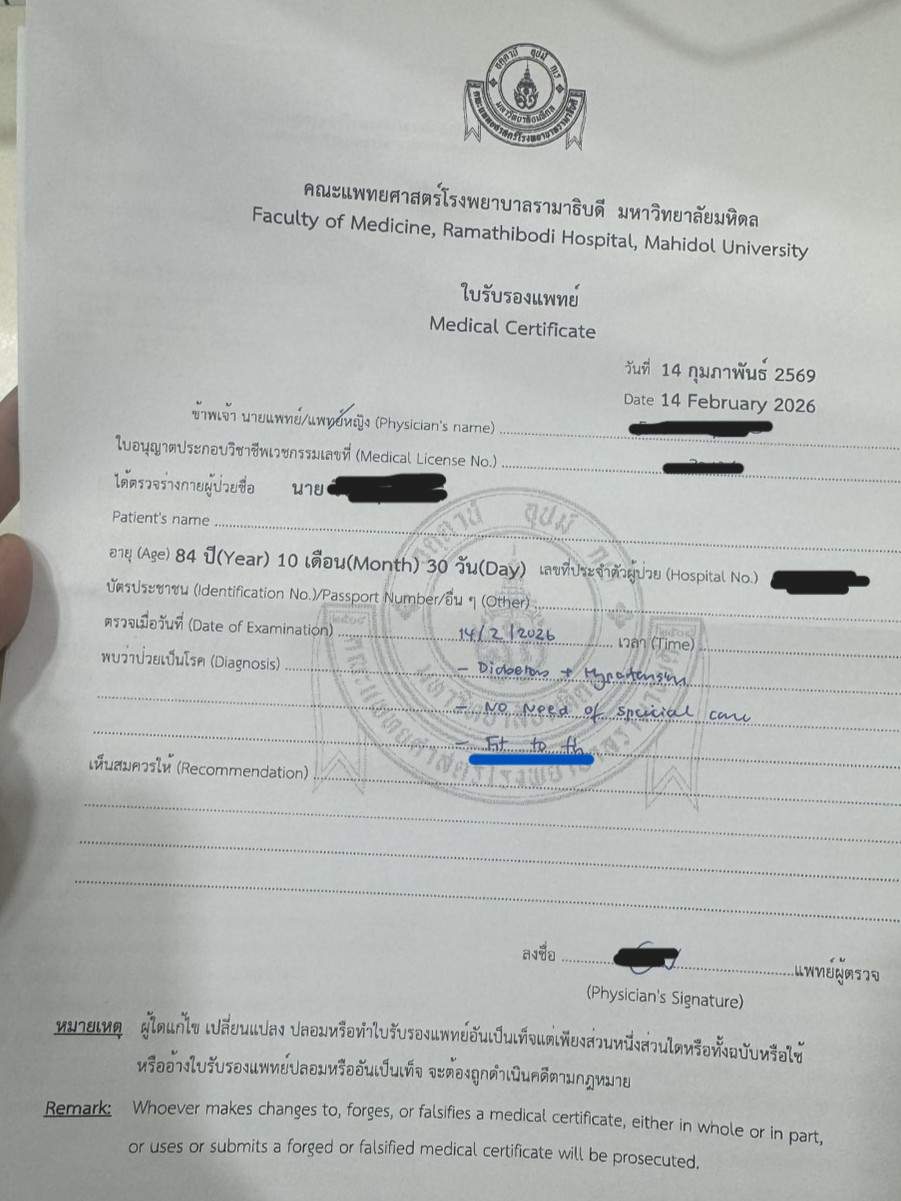
Budget airlines are terrified of the $15,000 to $600,000 cost of an emergency landing. This is why the “Good Health” clause is vague—it gives ground staff total discretion. To survive the “80+ Protocol,” we prepped our paperwork with these key details:
- The Name Match: Ensure the certificate uses the Thai name exactly as it appears in his passport for instant verification at the BKK counter.
- The Vitals Solution: The airlines asks for Blood Pressure and Respiratory details. While Xiaohongshu (Red Note) user suggest a full battery of EKGs and X-rays—which can be a costly deterrent in China—our strategy is a formal “Fit to Fly” remark on a stamped hospital letterhead.
- The Language Bridge: English certificates are the gold standard. While some suggest translating to Chinese, the cost and effort are often unnecessary if the English is clear and the phrase “Fit to Fly” is prominent.
5. 💡 Pro-Tips for the Certificate
Ask your doctor to include these phrases to ensure zero ambiguity for the ground staff:
- Condition Managed: “Patient’s chronic conditions are stable.”
- Fit for Air Travel: “Patient is medically fit for international air travel.”
- Self-Sufficient: “Condition managed via oral medication; patient is self-sufficient.”
6. The “Safe Landing” Update: Ground Reality
To be 100% prepared, we followed a “Low Profile” strategy, keeping our printed documents in our carry-on rather than emailing them ahead of time.
The Update: Despite our meticulous preparation of triple-redundant copies and hospital stamps, the medical certificate was not asked for by the airline during our journey. While Gung Gung’s fitness and frequent traveler status likely helped him pass unnoticed, having the documents was our “Get Out of Jail Free” card.
The Final Verdict
Gung Gung is a seasoned traveler, usually handled by Thai tour agencies, so these budget-airline warnings baffle him. However, when flying solo or with a small group on a budget carrier, a Medical Clearance is your “Get Out of Jail Free” card. Secure it early, ensure it has an official hospital stamp, and don’t assume your insurance policy will fight your battles at the boarding gate.
Have you ever been questioned about an elderly family member’s health at the gate? Share your experience in the comments!