The Flight, the Stranger, and the Data Breach: A Hard Lesson in PDPA
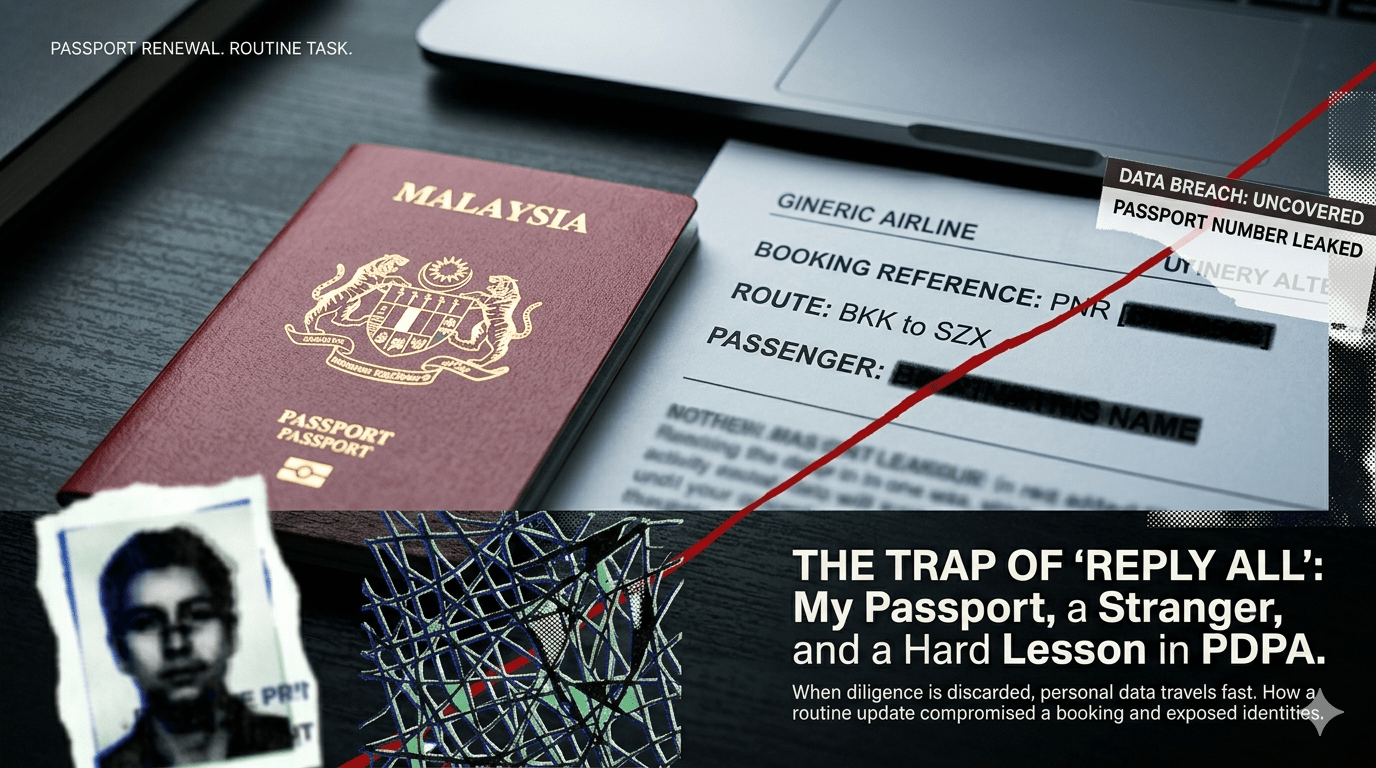
I recently renewed my passport for an upcoming trip to my husband’s ancestral village—a momentous pilgrimage marking the first time in a century his lineage has returned to their roots. Since my previous document (used for booking) fell short of the six-month validity requirement, I emailed the airline’s local office to update my details. While this technically can be done at the check-in counter, I wanted everything in order to avoid last-minute hurdles. It should have been a routine administrative task; instead, it became a textbook case of a compounded data breach.
The Timeline of a Leak
In my professional career, I’ve developed a strict habit: I rarely hit “Reply All.” Any multi-recipient email requires a manual check of the distribution list. However, when the airline staff replied to my request, they—for reasons unknown—copied an unrelated passenger into our correspondence.
The timeline that followed is a sobering look at how fast personal data travels when diligence is discarded:
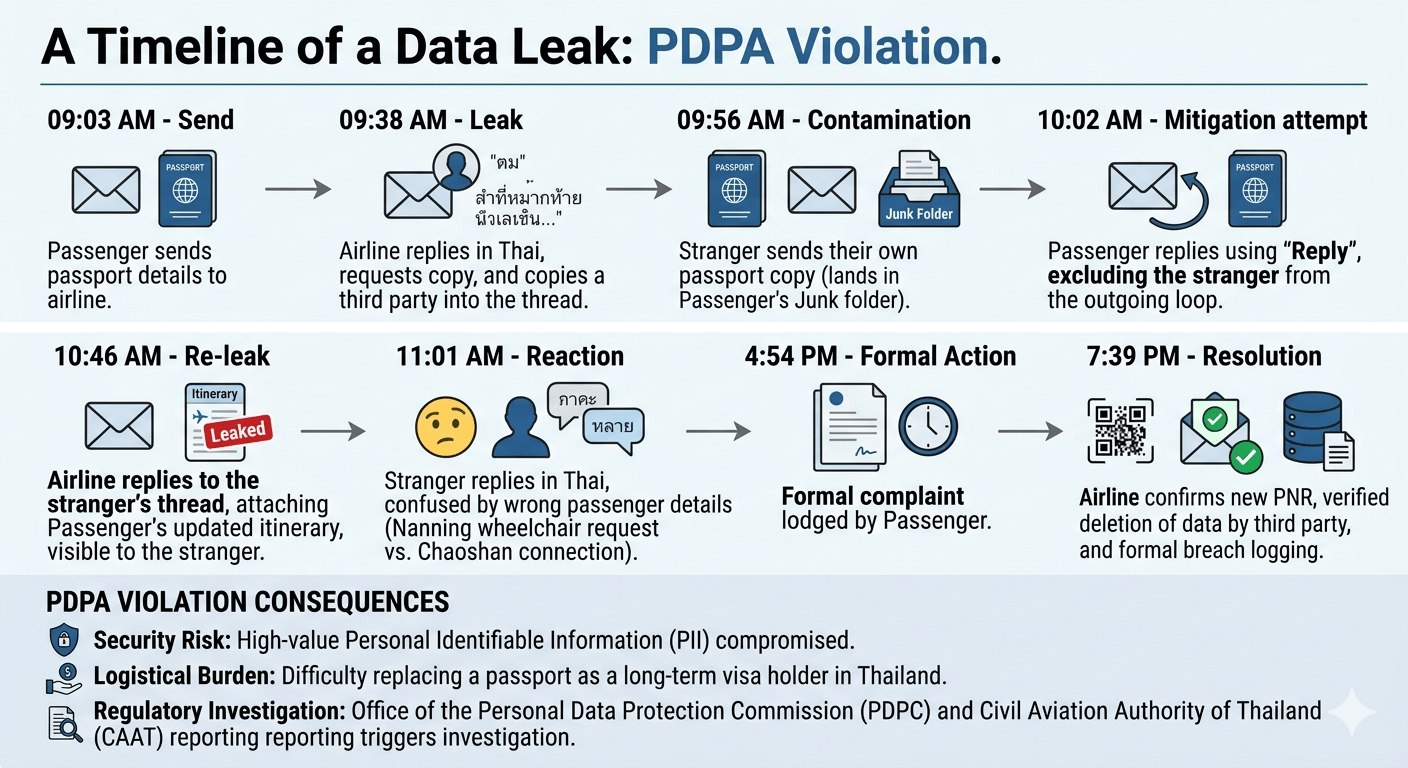
- 09:38 AM: The airline replied to my request, copying a third party (the “stranger”) into the thread.
- 09:56 AM: The stranger, unaware of the error, replied with her own passport copy into the same thread (it went to my “Junk” folder).
- 10:02 AM: I replied using the “Reply” function, effectively removing the stranger from my outgoing loop.
- 10:46 AM: Despite my attempt to “clean” the thread, the airline replied to the stranger’s original thread, attaching my updated flight itinerary (containing my PII) for her to see.
- 11:01 AM: The stranger replied, baffled: “Please double-check… We have no connection to this person.”
Even after the “red flag” was raised, the airline remained silent. The breach was re-exposed the following morning when the stranger sent an official complaint—including her passport (again!) in the trail—noting she had been asked to apologize for the “miscommunication.”
The Escalation: A Compound Breach
Initially, I thought only my data was at risk. However, a deeper audit revealed a much graver error: the airline had also exposed the full itinerary and passport number of my father-in-law, a senior passenger under my care. While a foreigner might navigate Thai law differently, the exposure of an elderly Thai citizen’s data carries significant weight.
This was no longer a single mistake; it was a triple violation:
- My PII leaked to a stranger.
- My father-in-law’s PII leaked to a stranger.
- The stranger’s PII leaked to me.
Taking Action: Beyond the “I’m Sorry”
Language was no excuse; I had written in both Thai and English to ensure total clarity. By 4:54 PM that day, I filed a formal complaint. When the airline initially offered a simple seat upgrade, I stood my ground. An upgrade doesn’t “un-leak” a passport number.
I reminded them of the Personal Data Protection Act (PDPA) and the statutory 72-hour window for a Data Controller to report a high-risk breach to the PDPC. I had, in fact, already begun filling out the PDPC complaint. In Thailand, failure to comply can result in administrative fines reaching into the millions of baht.
The Resolution: Sincerity Over Settlement
Initially, the airline offered to upgrade only my seat. I argued that this would separate me from my husband; eventually, we were both upgraded (a value of roughly 4,000 THB). A senior manager eventually intervened, and after several intense days, we reached a resolution that respected the gravity of the situation:
- Full Refund: All fees for the passengers under the primary booking (totaling roughly 22,000 THB) were waived.
- Meal Service: Complimentary meals were added for the remaining two passengers sharing my father-in-law’s PNR.
- Ticket Reissuance: New tickets were issued, ensuring our party of five remained together with our original 30kg baggage allowance—critical for the ancestral gifts we are carrying.
- Accountability: Most importantly, the airline acknowledged the systemic failure and provided a direct point of contact for the remainder of our journey.
Lessons for the Modern Traveler
I am withholding the airline’s name (and will forgo a public review for this trip) because their resolution showed a sincere effort to move toward genuine accountability. The senior manager who stepped in went above and beyond his typical function to resolve this.
However, let this be a lesson. If you face a breach in Thailand:
- PDPC (Office of the Personal Data Protection Commission): Your primary authority for data violations.
- CAAT (Civil Aviation Authority of Thailand): A report here impacts an airline’s operating score, which often carries more weight than a fine.
- Document Everything: Print-to-PDF your email threads immediately as evidence for the PDPC portal.
The Takeaway
This trip is an auspicious 100-year return to a family village. I chose not to pursue a multi-million baht penalty because I want this journey to be free of ill will. I also recognize that the aviation industry is fragile; a massive hit could cripple a carrier, ultimately hurting consumers through higher fares.
However, I made sure they understood that PII is high-value data. My advice? Minimize your digital trail. Use a fresh email thread for new requests rather than replying to old threads containing sensitive history. In the world of low-cost travel, we often expect “budget” service, but we should never accept “budget” security. If you don’t defend your data, no one else will.