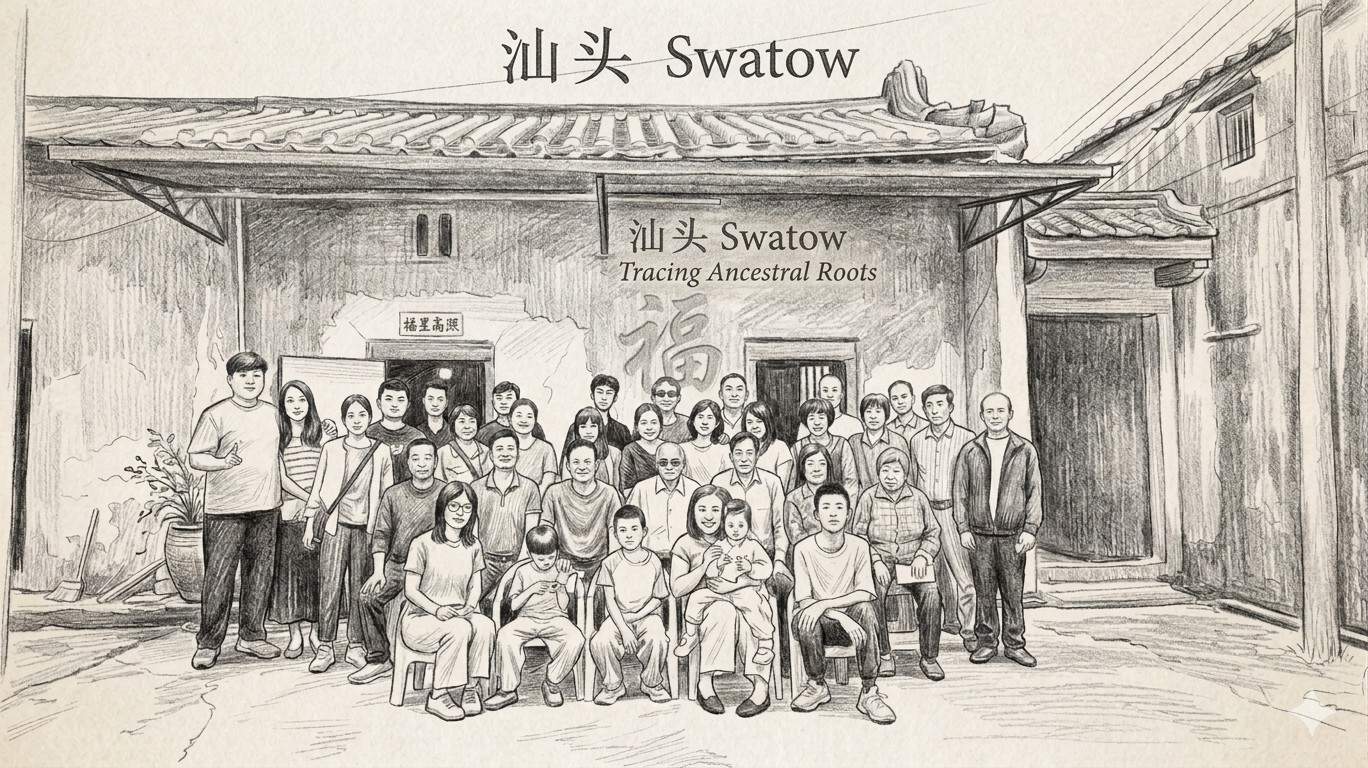
Solving More Payment Woes in China: The “Mini-Program” Savior

🚨 MAY 2026 POST-TRIP UPDATE: The Mini-Program Reality Check
We have officially returned from our 100-year ancestral journey, and I have a crucial “ground reality” update on how these digital tools actually performed. While I did my homework, the results were a mix of seamless wins and frustrating hurdles.
Luckin Coffee: The Caffeine Lottery
- The Win: I was the “lucky one” of the group! For me, the Luckin Mini-Program within Alipay worked perfectly.
- The Struggle: It was a different story for my husband and his sister. They faced significant difficulties; on my husband’s phone, the menu simply wouldn’t load, and the built-in translation feature failed.
- The Solution: If your app fails, don’t panic. When my sister-in-law couldn’t get her order through, the staff was incredibly helpful. They eventually placed a manual order for her and her boyfriend, and she simply transferred the payment directly to the staff member’s personal account.
Didi Mini-Program: The Reliable Ride
- This was a consistent win. Both my sister-in-law and I used the Didi Mini-Program on Alipay without any issues, making it our most reliable way to navigate shorter trips.
WeChat Mini-Programs: The Digital Dead-End
- The Loss: I ended up not using any WeChat mini-programs during the entire trip. Despite my pre-trip prep, my international travel debit card remained “greyed out” in the WeChat wallet, rendering me unable to process payments within their ecosystem.
The Verdict
Alipay was my absolute savior While it’s essential to have backups, Alipay proved to be the most resilient tool for an international traveler in China. If one platform fails you, remember that the local staff are often your best “workaround”—their kindness saved our daily coffee fix more than once!
Original Post: Digital Strategy for the 2026 Ancestral Journey
After sorting out my Alipay and the deposit for our car rental (check out that journey [here]), I started digging into the apps we’ll need daily. Let me tell you—it opened a whole new can of worms!
Many foreigners talk about the “Payment Wall” in China, and I have to agree. However, to be fair, we encountered plenty of payment complexities and failures in Norway, too. The real challenge in China is often the language barrier within apps—sometimes with no built-in translation. Just as we learned in Scandinavia, it’s wise to have multiple cards and several digital tool options ready; it’s almost inevitable that one might fail when you need it most.
Here is how I am navigating the digital landscape for our 2026 ancestral journey.
1. WeChat vs. Weixin Pay: The Communication Gateway
I sorted out my WeChat account last year to communicate with relatives and tour agencies. It wasn’t easy—WeChat verification typically requires a “referral” (an existing user scanning your QR code). For lapsed logins like mine, it was eventually sorted via an SMS code, but the hurdles were real!
The Win: Because my identity was already verified, linking my Thai travel debit card to Weixin Pay was seamless. WeChat isn’t just for chatting; it’s a gateway to Mini-Programs that solve the “International App Store” download issue.
Where to find Mini-Programs in WeChat:
- The Dropdown: Swipe down from the top of your “Chats” screen to see recently used or pinned programs.
- The Discover Tab: Tap “Discover” at the bottom, then “Mini Programs.”
- Pinned Programs: You can pin favorites like Luckin Coffee for easy access. Interestingly, I found that I couldn’t pin Didi in the same way, so keep that in mind!
💡 Note on Weixin Pay vs. WeChat Pay: While both are Tencent-operated, they differ by registration. Weixin Pay is the mainland version (using CNY), while WeChat Pay (like the HK version) often uses foreign currency. For most mainland transactions and mini-programs, having the Weixin Pay functionality activated via ID verification is the key to a smooth experience.
2. The Luckin Coffee Workaround


On our last trip, we struggled to order Luckin (瑞幸) because it’s strictly app-based. We even faced this in their Malaysia branch, where a kind staff member had to pay for us because we didn’t have the right digital wallet. I have recently read in forum that it’s possible to order at the counter, but that doesn’t seem to be an option when were in China previously.
The Strategy:
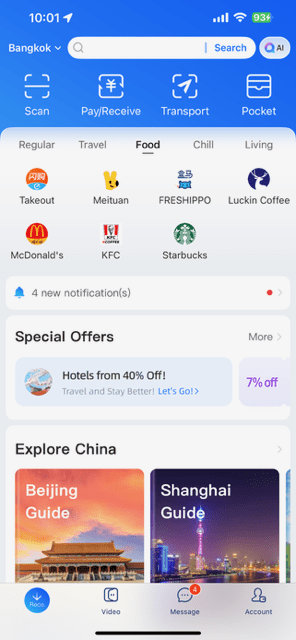
- The App Store Problem: You can’t download the Chinese Luckin app from a Thai/International App Store.
- The Solution: Use the Alipay Mini-Program.
- Why Alipay? Unlike WeChat, Alipay has a built-in translation function for the Luckin mini-program (I’ve tested it!). Plus, it’s easier to access via the Alipay “Food” tab. Since there is a Luckin Coffee right in our hotel building, this will be our breakfast and caffeine lifeline.
3. Didi & The 5-Person Problem
While we have a private 7-seater van for the main journey, we’ll need Didi (滴滴) for shorter trips once our 9-hour van allowance is up (additional hours cost 100 CNY/hour).
The Hurdles:
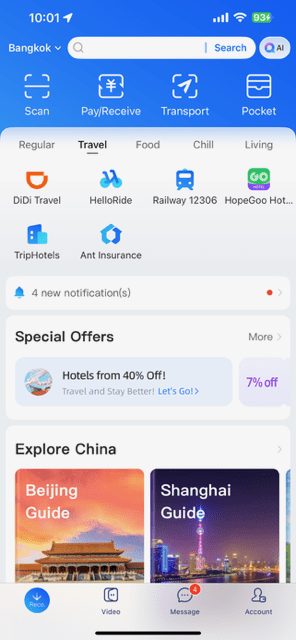
- Capacity: Didi mostly offers regular-sized vehicles. Since we are a group of five, we usually have to book two cars.
- The Card Binding Catch: I couldn’t bind my travel debit card to the standalone Didi app. While it works with my credit card, that incurs an extra 2.5% fee for overseas transactions.
- The Mini-Program Fix: By using the Didi Mini-Program within Alipay and WeChat, I can use my already-linked travel debit cards and save on those extra surcharges!
📍 Pinning Pro-Tip: To save your hotel (UrCove by Hyatt Shantou or 汕头龙湖凯悦嘉轩酒店), search the name in Didi, select the correct result, and tap the small star (☆) or “Collect/Favorite” (收藏) button. It becomes a one-tap shortcut!
🚨 BONUS TIP: The Hotel Booking “Secret”
I just discovered that it is often possible to book hotels directly via a WeChat Mini-Program, which can be significantly cheaper than international booking platforms.

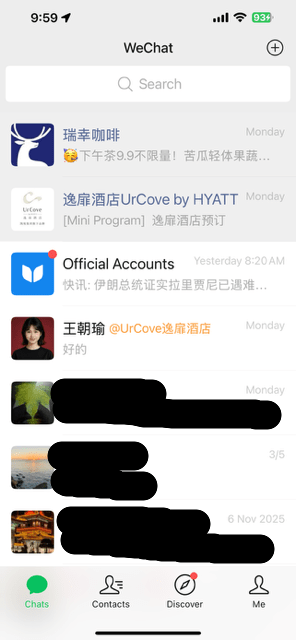
In my case, I couldn’t reach our hotel via the booking platform’s chat, and my direct emails went unanswered. This led me to search for the hotel’s official WeChat to communicate with them, which is how I discovered the Mini-Program.
- The Win: The Mini-Program has a direct call function to the specific branch and a QR code to chat with a real human, not an AI bot.
- The Catch: The interface, the voice calls, and the text chats are entirely in Chinese, so you’ll need a translation app (or a very patient friend) to navigate it. I am currently sorting out a new booking this way and will update on the results soon!
4. Amap vs. Mini-Programs
Many travelers recommend Amap (Gaode 高德) because it has an English interface. However, Amap acts as an aggregator (showing Didi plus other providers) and is often more expensive. Using the Didi mini-program directly inside Alipay/WeChat remains the most cost-effective route.
Final Thoughts: Preparation is Everything
I know many people find China “too troublesome,” but every country has its unique digital ecosystem. We learned this the hard way in Norway, so this time, we started early. Testing mini-programs and troubleshooting verifications months in advance turns a “headache” into a “minor inconvenience.”
Mini-Program Search Guide
To find these, open Alipay or WeChat, tap the search bar, and paste these Chinese names:
- Transportation (Didi): 滴滴出行
- Coffee & Breakfast (Luckin Coffee): 瑞幸咖啡
- Maps & Aggregated Rides (Amap): 高德地图
- Food Delivery & Reviews (Meituan): 美团
China, we are (almost) ready for you!